
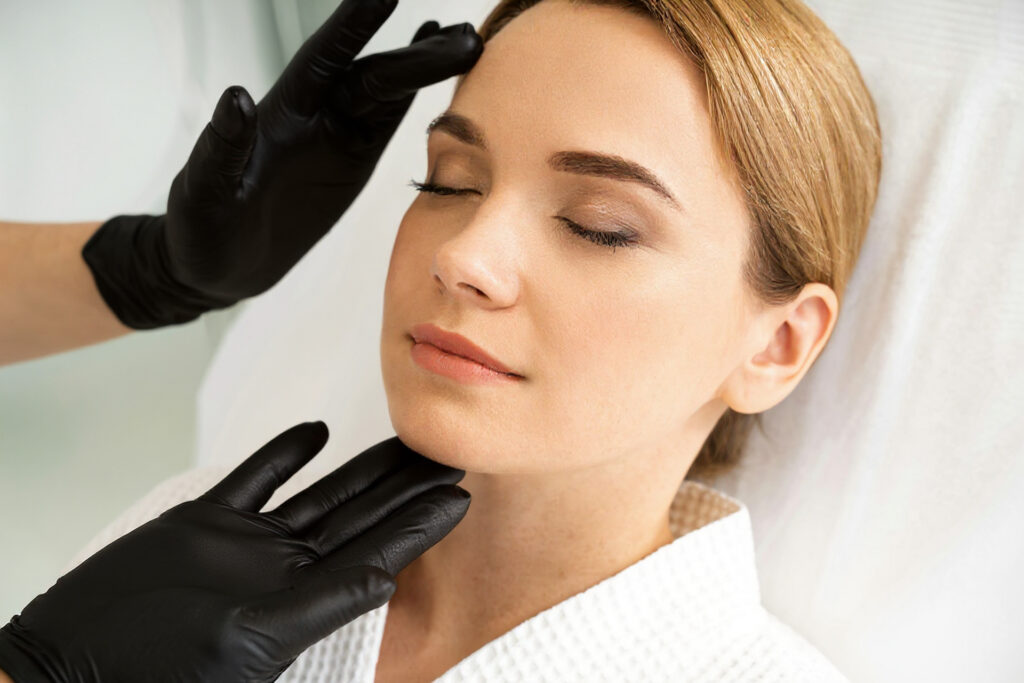
When someone comes in for an injectable consultation, they usually arrive with a specific concern.
“I don’t like these lines.”
“My under-eyes look tired.”
“My jawline is disappearing.”
It’s natural to assume that the solution is to treat exactly where the problem appears.
But facial aging doesn’t happen one wrinkle or one area at a time. Changes in one part of the face often affect how another part looks.
That’s why at Nuvel Skin & Laser, we start by assessing the whole face before recommending Botox, dermal fillers, or other treatments.
Treating the Concern vs. Understanding the Cause
One of the most important questions in aesthetic medicine is not:
“Where should we inject?”
It’s:
“Why does this area look different?”
Consider someone concerned about prominent nasolabial folds—the creases extending from the sides of the nose toward the mouth.
Simply placing filler into the fold may soften it. But the fold itself may only be part of the story.
Changes in the cheeks, facial fat, skin quality, and underlying skeletal support can all contribute to the way the lower face changes with age.
Understanding those relationships helps us decide whether the area should be treated directly, indirectly, with a combination of approaches – or sometimes not at all.
The Face Ages as a Three-Dimensional Structure
Facial aging is much more complicated than developing wrinkles.
Over time, changes occur at multiple levels, including:
- Bone
- Facial fat compartments
- Retaining ligaments and other supporting tissues
- Muscle activity
- Skin thickness, collagen and elasticity
These changes don’t occur uniformly.
Some areas lose volume. Others can appear heavier. Contours flatten, shadows deepen, and the proportions of the face gradually change.
This is why simply adding filler wherever there is a hollow or crease doesn’t necessarily produce a natural-looking result.
Sometimes the Problem Isn’t Where You Think It Is
This is one of the most interesting parts of facial assessment.
A patient may notice an under-eye hollow, but changes in the cheek and surrounding tissues may be contributing to it.
Someone concerned about their lower face may have changes occurring higher in the face that affect its overall proportions.
A patient bothered by a tired or stern expression may benefit more from modifying muscle activity with Botox than from adding volume.
And sometimes what appears to be a volume problem is primarily a skin-quality problem, where filler isn’t the best treatment at all.
The visible concern gives us a starting point. It doesn’t automatically tell us the treatment.
More Filler Isn’t Necessarily the Answer
A whole-face assessment doesn’t mean treating the whole face.
In fact, sometimes it means doing less.
The purpose of assessing facial proportions is to identify which changes matter and which don’t.
If one carefully selected treatment improves overall balance, there may be no reason to treat several additional areas.
Conversely, trying to correct a structural change with a very small amount of product placed in the wrong location may not produce a natural result either.
Natural-looking injectable treatment is therefore not simply about using less product.
It’s about using the appropriate treatment, in the appropriate place, for the appropriate reason.
Botox and Filler Solve Different Problems
A whole-face assessment also helps determine which type of injectable—if any—is appropriate.
Botox is primarily used to modify muscle activity and soften expression-related lines.
Dermal fillers can restore volume, improve structural support, and rebalance facial contours.
In some patients, combining the two produces a more balanced result than trying to make either treatment solve a problem it wasn’t designed to address.
Other patients may benefit more from treatments aimed at skin quality, such as laser, microneedling, or other regenerative and energy-based treatments.
The treatment should follow the diagnosis, not the other way around.
What We Look at During a Facial Assessment
Every face is different, but an assessment may include:
- Facial proportions and symmetry
- Areas of volume loss
- Bone structure and support
- Brow and eye position
- Cheek and midface contours
- Lips and perioral area
- Chin and jawline
- Muscle movement and facial expression
- Skin quality
- How the different areas relate to one another
We also consider something equally important:
What bothers you?
A technically perfect treatment plan isn’t useful if it doesn’t address the reason you came to see us.
The aim is to combine your priorities with an anatomical assessment and develop a treatment plan that makes sense for you.
The Goal Is to Look Better, Not Different
Good injectable treatment shouldn’t be about creating somebody else’s face.
For most of our patients, the goal is much simpler: looking rested, balanced, and refreshed while still looking unmistakably like themselves.
That requires planning before injecting.
Sometimes the best plan involves Botox. Sometimes it involves dermal filler. Sometimes it involves both. And sometimes the right recommendation is something else entirely.
Injectable Consultations at Nuvel Skin & Laser in Vernon, BC
At Nuvel Skin & Laser, injectable treatments begin with an individualized facial assessment.
We look beyond the wrinkle or feature that initially brought you through the door and consider the anatomy, proportions, movement, skin quality, and structural changes contributing to what you see.
From there, we can decide together whether treatment is appropriate and what approach is most likely to produce a natural-looking result.
If you’re considering Botox or dermal fillers in Vernon, BC, book a consultation with Nuvel Skin & Laser to start with a personalized assessment.